Learn more about the research of the Structure and Properties of Complex Materials Group.
TOPICS
We study the correlation between structure, bonding and properties in a variety of complex materials for application in thin film photovoltaics, transparent electronics or data storage. A main focus of our work is the determination of the element-specific atomic-scale structure and its influence on important material properties. A comprehensive understanding of the correlation between preparation conditions, chemical composition, short-range and long-range structure as well as optical and electrical properties is indispensable in order to utilise the full potential of these materials in the future. To that end, we also collaborate closely with a number of national and international research groups.
Chalcogenide compound semiconductors, such as chalcopyrites and kesterites, are promising absorber materials for thin film photovoltaics. Solar cells based on (Ag,Cu)(In,Ga)(Se,S)2 have reached record conversion efficiencies of more than 23 % and feature excellent long-term stability. Recent commercial applications include classical roof-top installations but also Building Integrated Photovoltaics (BIPV) like solar cell facades.
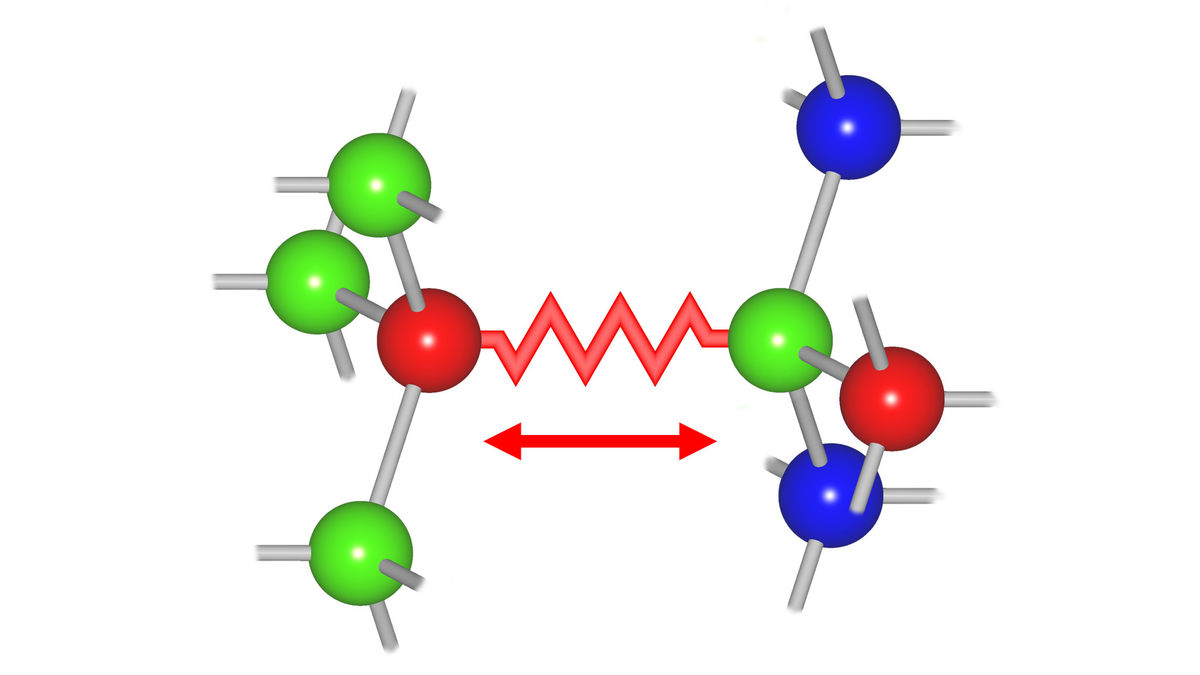
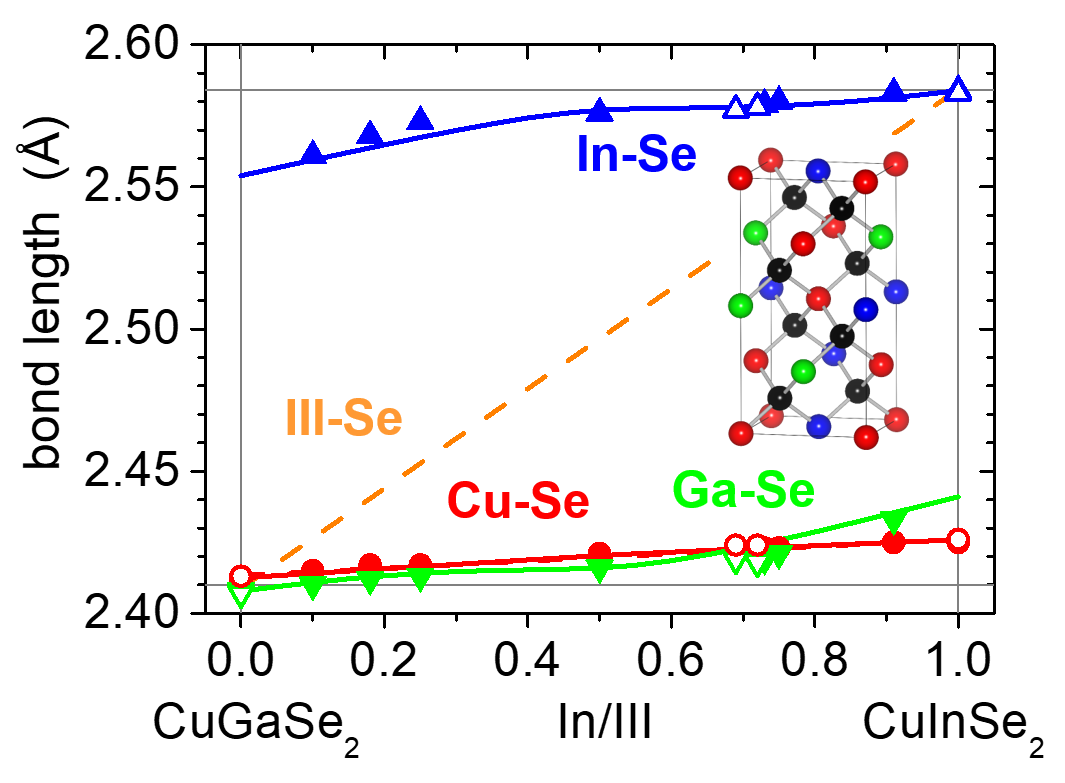
The material properties of (Ag,Cu)(In,Ga)(Se,S)2 and other chalcopyrite and kesterite semiconductors can be specifically tailored by adjusting the elemental composition. However, the materials are also intrinsically inhomogeneous, featuring different local atomic configurations on the subnanometre scale. Our studies clearly show that these local configurations feature different structural parameters. Most strikingly, the element-specific bond lengths are distinctly different even if two elements share the same lattice site in the crystal structure. The material is thus characterised by severe atomic displacements and bond angle distortions.
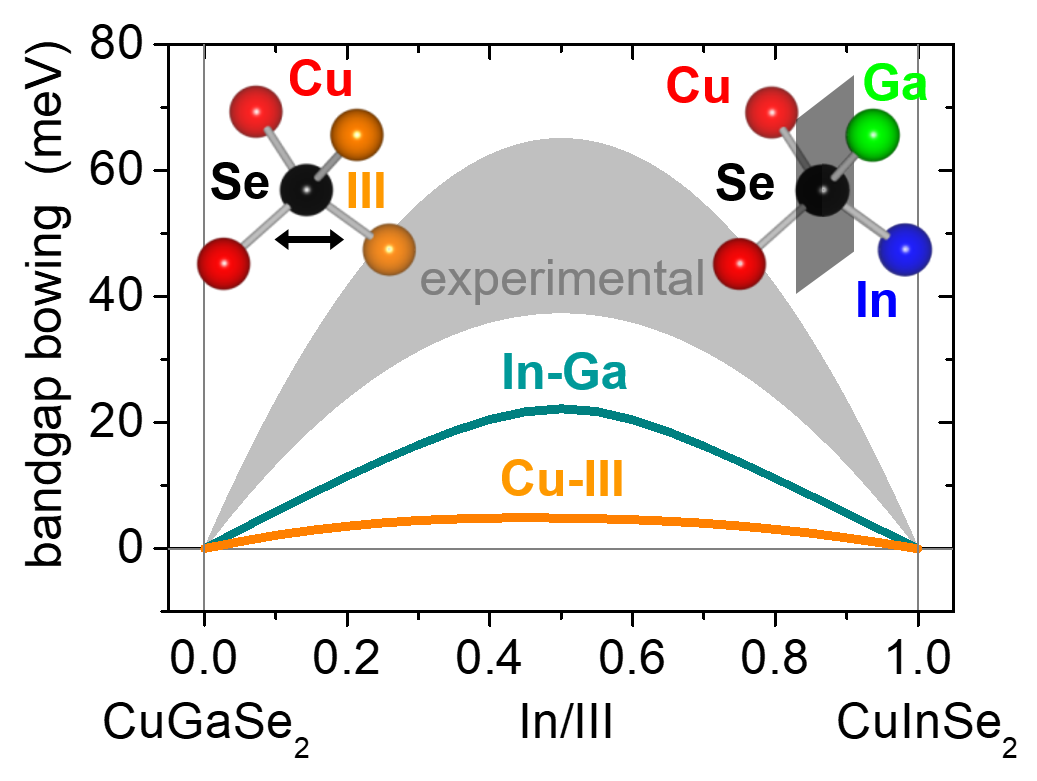
This striking deviation between the element-specific local structure and the average crystallographic structure affects other important material properties. The atomic displacements, for example, change the bandgap energy as demonstrated by theoretical calculations. Using a valence force field approach, we show that the element-specific local structure therefore contributes to the nonlinear change of the bandgap with changing elemental composition, the so-called bandgap bowing. The bandgap energy is one of the central material properties that determine the efficiency of a photovoltaic device. The detailed knowledge of the element-specific local structure is thus indispensable in order to understand, model and optimise the properties of (Ag,Cu)(In,Ga)Se2 for high-efficiency thin film solar cells.
Driving factors for the peculiar bond length dependence and tetragonal distortion of (Ag,Cu)(In,Ga)Se2 and other chalcopyrites
H. H. Falk et al, Journal of Physics: Energy 7, 015004/1-17 (2025)
Peculiar bond length dependence in (Ag,Cu)GaSe2 alloys and its impact on the bandgap bowing
H. H. Falk et al, APL Materials 11, 111105/1-6 (2023)
We have performed similar studies also for the kesterite semiconductors Cu2Zn(Sn,Ge)Se4 and (Ag,Cu)2ZnSnSe4.
Atomic scale structure of (Ag,Cu)2ZnSnSe4 and Cu2Zn(Sn,Ge)Se4 kesterite thin films
K. Ritter et al, Frontiers in Energy Research 9, 656006/1-8 (2021)
Atomic scale structure and its impact on the band gap energy for Cu2Zn(Sn,Ge)Se4 kesterite alloys
K. Ritter et al, Journal of Physics: Energy 2, 035004/1-9 (2020)
Transparent conductors and semiconductors are widely used in solar cells, flat panel displays and LEDs. They will also enable future applications such as smart windows and transparent displays. While high-performing n-type materials are readily available, their p-type counterparts are still lagging behind.
Copper iodide (CuI) is one of the most promising p-type materials, combining high conductivity and excellent optical transparency. For application as transparent electrode or hole transport layer, however, an even higher conductivity is desirable. This can be achieved by doping CuI with elements such as S, Se, Rb or Cs. Undoubtedly, the details of the dopant incorporation affect the electronic properties of the material and hence the doping efficiency. Therefore, we investigate the local structure and coordination of CuI thin films doped with Se or Cs.
In contrast, application of CuI in active electronic devices, such as thin film transistors, requires a reduction of the charge carrier concentration. This can be achieved by alloying CuI with AgI or CuBr. However, it is well known for many semiconductor alloys that the element-specific local structure deviates from the average crystallographic structure. This deviation affects other important material properties such as the bandgap energy. Therefore, we study the atomic-scale structure of (Ag,Cu)I and Cu(Br,I) to determine local structural parameters such as element-specific bond lengths and atomic displacements.
Amorphous oxides are particularly suitable for flexible electronic devices. Zn-Sn-O and Cu-Sn-O are promising, abundant alternatives to the already established In-Ga-Zn-O. By definition, amorphous materials lack any long-range order. Furthermore, the local structure can accommodate a range of configurations with varying structural parameters, which again influences the optical and electrical properties of the material. Therefore, we also investigate the short-range order and coordinations of amorphous Zn-Sn-O and Cu-Sn-O thin films.
Cs-doped and Cs-S co-doped CuI p-type transparent semiconductors with enhanced conductivity
A. S. Mirza et al, Advanced Functional Materials 34, 2316144/1-10 (2024)
Oxygen-induced phase separation in sputtered Cu-Sn-I-O thin films
E. M. Zollner et al, Physica Status Solidi A 220, 2200646/1-10 (2023)
Phase change materials, such as antimony (Sb), germanium telluride (GeTe), germanium antimony telluride (Ge-Sb-Te) and bismuth telluride (Bi2Te3) are interesting for data storage and thermoelectric applications. Most prominently, Ge-Sb-Te is already widely used in so-called Phase Change Random Access Memory devices.
Many application relevant material properties are determined by the bonding characteristics of a given material. Therefore, we study the nature and strength of bonding in phase change materials such as Sb, GeTe and tin telluride (SnTe). The strength of a bond, described by its force constant, can be determined from the temperature dependence of the atomic vibrations. In our study, we compare a comprehensive set of materials, including metals, semiconductors and phase change materials. We show that the dependence of the force constants on the interatomic distance is characteristic of the type of chemical bonding, i.e. metallic, covalent or electron-rich multi-centre bonding, respectively. Experimental and theoretical force constants can thus be used to predict the bonding characteristics of novel materials, aiming for a targeted optimization of their application relevant material properties.
Our results further demonstrate that antimony in its stable phase exhibits characteristics of both classical localized covalent bonding and electron-rich delocalized multi-centre bonding. This proves that there is a continuous transition between these two types of bonding. The degree of covalent bonding versus multi-centre bonding further correlates with the local structure of the material, in particular the so-called Peierls distortion. These findings contribute to a deeper understanding of phase change materials and their versatile material properties.
Experimental and theoretical force constants as meaningful indicator for interatomic bonding characteristics and the specific case of elemental antimony
F. Zahn et al, Advanced Materials 37, 2416320/1-11 (2025)
We also apply our expertise in X-ray absorption spectroscopy (XAS) to the advancement of related analytical techniques.
X-ray excited optical luminescence (XEOL) is used to study optically active centres or defects in a variety of materials. Combined with spatial and temporal resolution, XEOL is applied for multimodal analysis of hetero- and nanostructures. Simultaneous XEOL and X-ray absorption spectroscopy (XAS) measurements can provide element and site selective structural information. However, the intensity of the XEOL signal exhibits an intricate dependence on X-ray energy, selected optical emission and thickness of the sample. All effects can be successfully reproduced by one generalized model. This model takes into account the experimental geometry, the creation, diffusion and recombination of charge carriers and the re-absorption of X-ray and optical photons. The model thus enables a quantitative analysis of simultaneous XEOL-XAS measurements.
Role of sample thickness and self-absorption effects in simultaneous XEOL-XAS measurements on single crystalline ZnO and GaN
S. Levcenko et al, Physical Review Research 7, 023066/1-15 (2025)
Electron energy loss spectroscopy (EELS) is a method similar to XAS. The main difference is that the excitation of the core electrons is caused by an electron beam rather than an X-ray beam. Recent technical developments have extended the accessible energy range to that commonly used in hard X-ray XAS. This enables the analysis of the extended fine structure also for this extreme electron energy loss spectroscopy (XEELS). Protocols similar to XAS analysis provide structural parameters such as element-specific bond lengths, but combined with the spatial resolution of an electron microscopy setup
Enabling electron-energy-loss spectroscopy at very high energy losses: An opportunity to obtain x-ray absorption spectroscopy-like information using an electron microscope
S. Lazar et al, Physical Review Applied 23, 054095/1-12 (2025)
Technical progress has also enabled the recent advent of laboratory-based X-ray absorption spectroscopy (lab-XAS). As the user community grows, the instrumental capabilities in terms of energy range, detection limits and sample environments are constantly expanded. We contribute to this development by systematically evaluating the analytical capabilities, for example the resolution and uncertainty of element-specific bond lengths determined from lab-XAS measurements.
METHODS
We use X-ray absorption spectroscopy (XAS) as the main analytical method of our group, both at the synchrotron and in the lab. We also apply other X-ray spectroscopies, including X-ray emission spectroscopy (XES), X-ray fluorescence spectroscopy (XRF) and X-ray excited optical luminescence spectroscopy (XEOL). These techniques are complemented by established methods for characterising the chemical composition, morphology and crystal structure of a material. In many cases, we further combine our results with density functional theory (DFT) based calculations performed by our collaboration partners.
X-ray absorption spectroscopy (XAS) measures the X-ray absorption coefficient of a material as a function of X-ray energy at and above the absorption edge of a particular element. Therefore, XAS is an element-specific probe.
The X-ray absorption near edge structure (XANES) depends on the unoccupied electronic states of the absorbing atom and on its three-dimensional geometric environment. The XANES thus contains information about the type and number of neighbouring atoms, their distance and their coordination symmetry. However, the correlation is far from trivial and disentangling the effect of the different properties usually requires extensive theoretical calculations. Therefore, a qualitative analysis is often performed by comparing the measured XANES spectra of the samples of interest with those of known reference materials.
The extended X-ray absorption fine structure (EXAFS) is determined by the one-dimensional interatomic distance distribution of the neighbouring atoms. The EXAFS thus depends on coordination number, bond length and disorder. These structural parameters are typically analysed by a path fitting approach, in which theoretically calculated spectra are refined to match the experimentally measured ones. The disorder originates both from static variations of the interatomic distances and from thermal vibrations of the atoms. Temperature-dependent EXAFS measurements thus provide information about the vibrational behaviour of the atoms and hence about the bonding characteristics of the material.
Due to its short-range nature, XAS can be used to study crystalline, disordered and amorphous materials. The resulting information about the element-specific atomic-scale structure is highly complementary to that obtained by other techniques such as diffraction or electron microscopy.
X-ray emission spectroscopy (XES) measures the intensity of individual characteristic X-ray fluorescence lines with very high spectral resolution. To create the X-ray fluorescence, the atoms in the material are excited by X-rays. The exact position and line shape of the emitted fluorescence contain information about the oxidation state, spin state and chemical bonding of the emitting atoms. Similar to X-ray absorption spectroscopy (XAS), XES is element-specific and thus provides valuable insight into the local structure and electronic properties of complex materials.
X-ray fluorescence spectroscopy (XRF) measures the intensity of the entire X-ray fluorescence emitted by a material as a function of the energy of the emitted X-ray photons. To create the X-ray fluorescence, the atoms in the material are excited by X-rays. The occurrence of a characteristic fluorescence line indicates the presence of the corresponding element. Evaluating the intensities of different characteristic lines yields the amount of each element present. XRF thus provides the chemical composition of the material. For thin films, ranging from tens of nanometres to several micrometres, the film thickness can also be determined by XRF analysis.
X-ray excited optical luminescence spectroscopy (XEOL) measures the spectrally resolved optical luminescence emitted by a material after absorption of an X-ray beam. The optical luminescence is a product of the relaxation cascade following the initial ionization of an atom, similar to the emission of X-ray fluorescence. The XEOL signal contains information about optically active defects and luminescent centres. It can be used to investigate a wide range of materials, including semiconductor thin films and nanostructures, rare-earth-doped oxides and metal clusters.
INSTRUMENTATION
Our group is equipped with a laboratory-based X-ray absorption and emission spectrometer, an X-ray fluorescence spectrometer, an optical spectrometer and a sample preparation lab. We also have access to X-ray diffractometers and electron microscopes hosted by our in-house collaboration partners. Furthermore, we regularly perform XAS experiments at synchrotron light sources such as PETRA III (DESY).
easyXAFS 300+
- energy range 5 - 12 keV (up to 20 keV with reduced performance)
- 1.2 kW liquid-cooled X-ray tube for XAS mode + 100 W air-cooled X-ray tube for XES mode
- various Si and Ge spherically bent crystal analysers
- large-area SDD detector
- sample stages for transmission XAS, fluorescence XAS and XES
- cold stage with a Stirling cryo cooler for temperatures down to 40 K
Beamline P65 @ PETRA III (DESY)
- energy range 4 - 44 keV
- Si111 and Si311 monochromators
- Si, Rh and Pt mirrors
- transmission and fluorescence mode
- 4-pixel Vortex SDD detector, ionization chambers
- liquid-He cryostat